Your next client just searched “personal injury lawyer near me” on Google. They scanned the first three results, read a few reviews, and picked up the phone.
It was not you.
Not because you are a bad lawyer. Not because your fees are too high. Simply because your firm was not visible at the moment they were ready to hire.
That is the reality of legal marketing in 2026. Clients are not waiting for recommendations. They are not flipping through directories. They open Google, type what they need, and choose from whoever shows up on page one.
If SEO is not part of your firm’s strategy right now, you are not just missing traffic. You are handing clients directly to your competitors.
This post makes the full business case for why SEO is important for lawyers in 2026 — covering the market shift, the competitive reality, and the specific reasons it is now one of the most critical investments a law firm can make.
Already familiar with what SEO is? Read our complete guide: SEO For Law Firm: The Complete Guide to Getting More Clients Online
How Today’s Legal Clients Find a Lawyer
The way people find legal help has fundamentally changed over the last five years — and 2026 represents the clearest shift yet.
Studies consistently show that more than 96% of people seeking legal advice begin with a search engine. That number has only grown as smartphones became the default device for nearly every online activity.
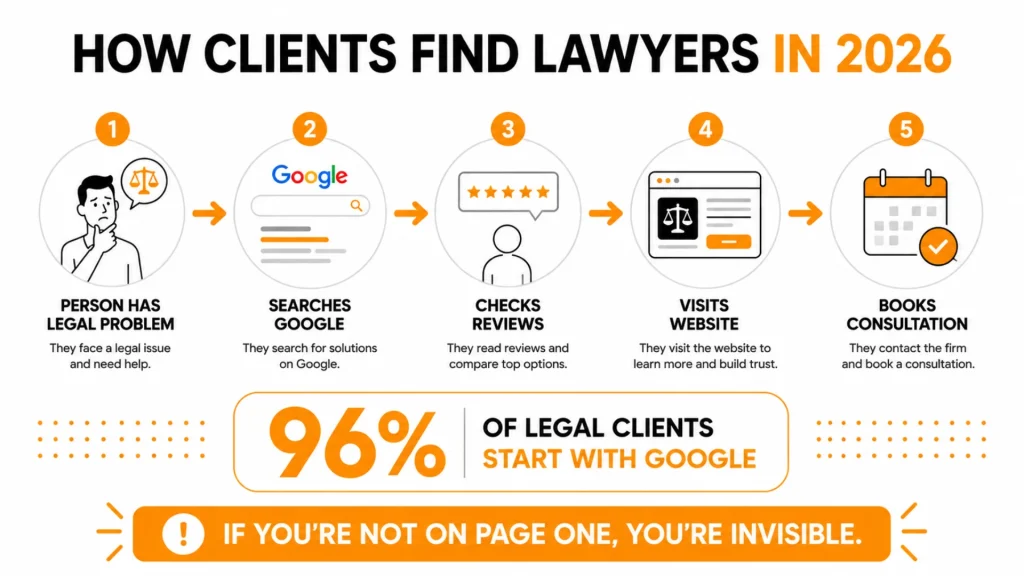
Here is what that journey looks like in practice:
Someone experiences a car accident, a difficult divorce situation, or an immigration issue. Before they call anyone, they go to Google. They type a phrase like “divorce attorney in Manchester” or “immigration lawyer near me.” They scan the top results, check a few reviews, visit one or two websites, and make contact within minutes.
What is striking is that even referred clients follow this same pattern. They receive a recommendation from a friend or colleague, then immediately search the firm’s name on Google to verify credibility. If the website looks outdated, has no reviews, or does not rank confidently for its own brand — trust drops.
In 2026, visibility is your first impression. Before you speak to a client, before they read your credentials, before they see your office — they have already formed an opinion based on your presence in search results.
This is the foundation of why SEO is no longer optional for law firms.
Why Competition for Legal Clients Online Has Intensified
The legal market online is not just competitive. In 2026, it is one of the most contested spaces in all of local search.
Large national firms have invested heavily in content, backlinks, and technical infrastructure. Legal aggregator platforms — Avvo, FindLaw, Justia — occupy top positions for thousands of high-value legal keywords. These are platforms that lawyers often pay to be listed on, yet they consistently outrank those same lawyers in organic results.
At the same time, Google Ads costs for legal keywords have become extraordinary. Phrases like “personal injury lawyer” or “DUI attorney” can cost significant amounts per click. For smaller and mid-size firms with limited marketing budgets, running paid campaigns as a primary strategy is increasingly difficult to sustain.
The result is a market where firms that invested in organic SEO twelve to eighteen months ago are now dominating their local searches. They are not spending more. They are simply more visible because they built a foundation early.
The firms that are struggling are the ones who delayed. Every month without SEO is a month where a competitor builds more authority, more reviews, more content — and widens the gap.
10 Reasons Why Lawyers Cannot Ignore SEO in 2026
1. Your Clients Are Already Searching — You Might Not Be Showing Up
High-intent legal searches happen millions of times every single day. Every search for “family lawyer near me” or “criminal defense attorney consultation” is a potential client actively looking for help.
Not appearing on page one means not existing for that client. It does not matter how experienced your team is or how strong your reputation is offline. If Google cannot find you, neither can they.
2. SEO Delivers Higher-Quality Leads Than Most Other Channels
Organic search leads are different from most marketing-generated contacts. When someone searches “employment lawyer in Birmingham” and clicks your website, they are not browsing casually — they have a legal problem and are actively looking for someone to solve it.
This intent-driven traffic converts at a much higher rate than display ads, social media traffic, or cold outreach. The lead has already pre-qualified themselves before they ever contact you.
3. It Builds Trust Before You Even Answer the Phone
Ranking on page one of Google is, for most people, an implicit endorsement. Whether or not that is rational, it influences decisions. A firm that appears in the top three results is perceived as more credible, more established, and more trustworthy than one buried on page two.
Add to that a well-structured website, clear service pages, and a strong set of Google reviews — and a prospective client has already formed a positive impression of your firm before any human interaction occurs.
SEO builds trust at scale, 24 hours a day.
4. Local SEO Puts You on the Map — Literally
Google’s local pack — the map section that appears at the top of local search results — is one of the highest-converting placements in all of digital marketing for service businesses. For law firms, appearing in those top three map listings often generates more phone calls than regular website rankings.
Local SEO focuses on your Google Business Profile, reviews, NAP (Name, Address, Phone) consistency across directories, and location-based content. Small and mid-size firms can absolutely compete here — and often outrank much larger firms if their local signals are stronger.
We break down the full local SEO process in: How Law Firm SEO Works (Step-by-Step Explained)
5. Google AI Overviews Are Rewarding Authoritative Legal Content in 2026
This is one of the most important 2026-specific developments every lawyer needs to understand.
Google’s AI Overview feature — which now appears at the very top of many search results — generates a summarized answer to a user’s query by pulling from content it considers the most authoritative and well-structured across the web.
When someone types “do I need a lawyer for a personal injury claim,” Google’s AI does not just show ten blue links. It now provides a direct answer — pulled from websites that have demonstrated expertise, clear structure, and trustworthiness. If your firm’s content is well-organized, genuinely helpful, and backed by E-E-A-T signals (Experience, Expertise, Authoritativeness, Trustworthiness), it has a real chance of appearing inside that AI-generated response.
This is the new frontier of search visibility. The law firms that are investing in high-quality, well-structured content now are positioning themselves to be featured inside AI-driven results — a placement that did not exist three years ago.
At Organic SEO IT, optimizing for AI Overview eligibility is now a core part of every law firm SEO strategy we build. It requires a specific approach: direct answers, logical heading structure, FAQ sections, and content that fully addresses the user’s legal question — not just keyword-stuffed paragraphs.
6. Referrals Alone Are No Longer Enough to Scale
Referral networks are valuable. No one is suggesting otherwise. But they have a ceiling.
You can only receive as many referrals as your existing network can provide. You can’t control the volume and cannot predict the type of cases. And if a key referral source moves, retires, or changes, your pipeline suffers.
SEO does not have that ceiling. A well-ranked law firm website functions as a 24/7 business development tool — generating inquiries from people you have never met, in practice areas you are targeting, at a volume that scales with your content and authority.
Firms that combine strong referral networks with a solid organic presence are the ones growing consistently in 2026.
7. Your Competitors Are Already Investing
Here is an uncomfortable truth: while you are reading this, some of your local competitors are ranking above you because they started SEO earlier.
SEO is cumulative. Every optimized page, every published article, every earned review, every quality backlink builds on the last. A firm that has been investing for eighteen months has an authority advantage that takes time to overcome.
Waiting another six months does not just delay your results. It widens the gap you will eventually have to close.
8. SEO Reduces Your Long-Term Marketing Costs
The economics of organic SEO improve dramatically over time. In the early months, you are investing time and resources to build a foundation. But once pages are ranked, they continue generating traffic and leads without ongoing cost-per-click fees.
Compare that to Google Ads, where every single visitor costs money. The moment you pause spending, the traffic stops. With SEO, a strong piece of content or a well-optimized service page can bring in qualified leads for years.
For law firms looking at sustainable growth rather than expensive month-to-month advertising, SEO is the only channel that genuinely compounds.
9. Content Authority Positions You as the Expert Lawyer in Your Region
Google’s ranking systems in 2026 are increasingly sophisticated about evaluating expertise. For legal content specifically, E-E-A-T signals matter enormously. Google wants to surface the most credible, experienced, and trustworthy sources for legal queries — because the stakes of bad legal advice are high.
Law firms that consistently publish accurate, practical, helpful content around their practice areas build what SEO professionals call topical authority. Google begins to recognize the site as a reliable resource for that subject area, and rankings improve across multiple related pages.
This also positions the firm as a thought leader in their local market. Clients reading your guides, your FAQ articles, your explanations of legal processes — they arrive at a consultation already trusting your expertise.
10. It Works While You Are in Court
Perhaps the most practical reason of all.
Your business development time as a lawyer is extremely limited. Between client work, court appearances, filings, and consultations — there is very little time left for active marketing.
SEO does not require your ongoing attention once the foundation is built. A ranked page generates inquiries at 11pm on a Tuesday. It brings in a consultation request while you are in a three-hour hearing. Your website becomes your most consistent, lowest-maintenance source of new business.
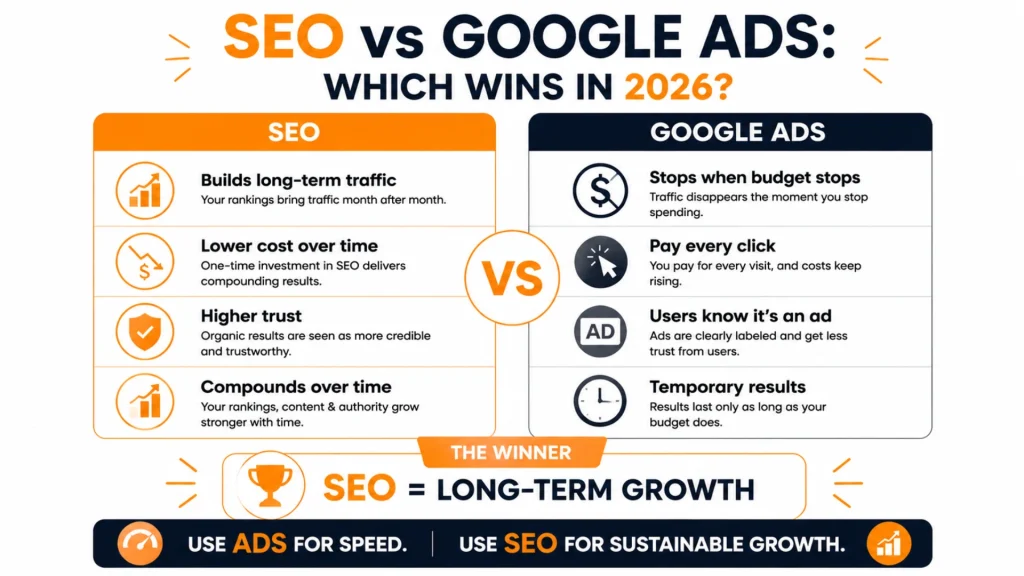
SEO vs. Paid Ads for Lawyers — What Works Better in 2026?
This is a question every law firm asks eventually, and the honest answer is that they serve different purposes.
| SEO | Google Ads (PPC) | |
| Cost over time | Decreases as authority grows | Fixed — you pay per click, forever |
| Time to results | 3–12 months | Immediate |
| Trust signals | High — organic results feel credible | Lower — users know it is an ad |
| Longevity | Long-term — ranked pages persist | Short-term — stops when budget stops |
| Scalability | Scales with content and authority | Scales with budget only |
| Lead quality | High intent | High intent but more variable |
Paid ads have a role — particularly for new firms that need leads immediately while their SEO foundation is being built. But relying solely on ads is a fragile strategy. Budget cuts, account issues, or rising competition can cut your lead flow overnight.
The firms building real, sustainable growth in 2026 are treating SEO as the foundation and using ads as a complement — not the other way around.
At Organic SEO IT, we have seen this firsthand working with law firms across the UK. The ones scaling most reliably are those who committed to organic growth early and now spend far less per acquired client than their ad-dependent competitors.
The Real Cost of Ignoring SEO as a Lawyer
It is easy to think of SEO as something you will get to eventually. The problem is that delay has a real cost — even if it is invisible.
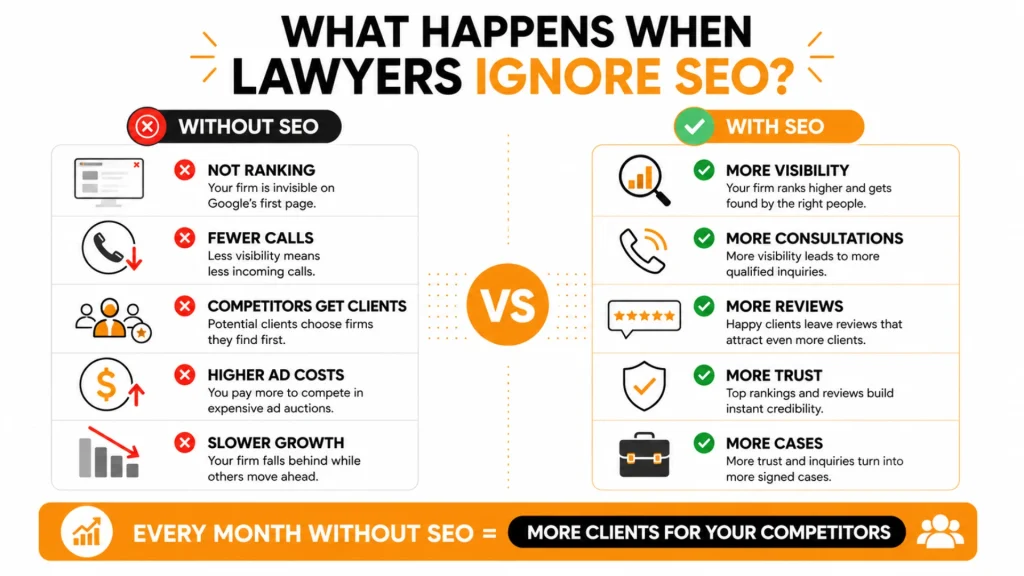
Every month without SEO investment is a month where a competitor:
- Publishes more content and builds more topical authority
- Earns more reviews and strengthens their local rankings
- Acquires more backlinks that increase their domain credibility
- Ranks for more keywords that capture clients you could have had
The cost of ignoring SEO is not just the leads you miss today. It is the compounding advantage you are giving to the firms that are investing right now.
We have seen this play out with legal clients at Organic SEO IT — firms with excellent reputations and genuine expertise losing market share to competitors with stronger digital presence. The quality of legal service matters. But clients cannot evaluate your legal skill until they find you first.
Visibility is the prerequisite for everything else.
Getting Started With Legal SEO in 2026
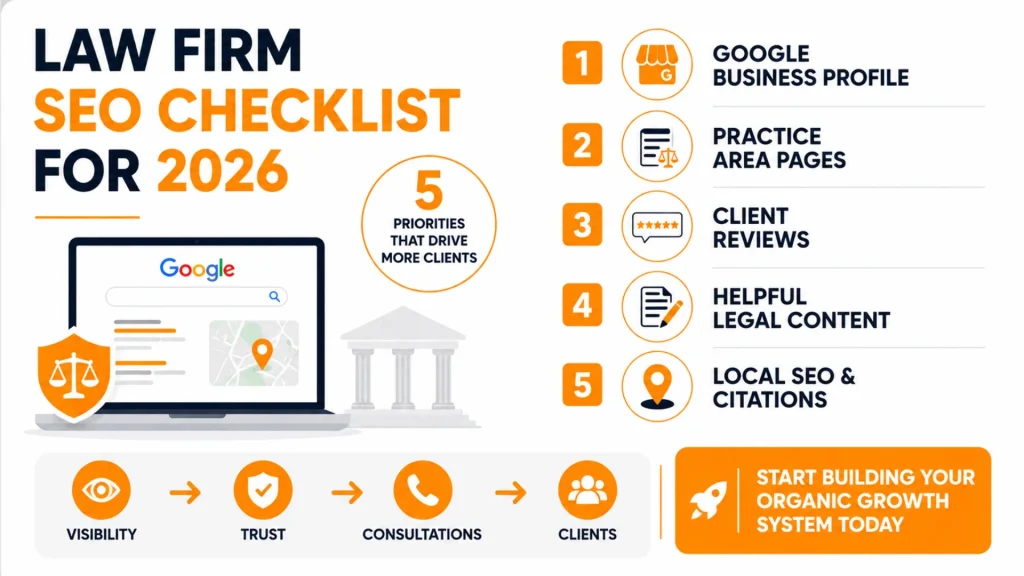
If you are starting from scratch or recognizing gaps in your current strategy, here are the five areas to focus on first:
1. Audit your visibility. Search your key practice areas and location on Google. Where do you appear? Where do your competitors rank? This baseline tells you everything about the gap you need to close.
2. Claim and optimize your Google Business Profile. This is the single fastest win for local law firms. A complete, actively managed profile with real photos, accurate service categories, and regular reviews can move the needle quickly.
3. Build dedicated service pages. Every practice area deserves its own detailed page — not a bullet point on a generic services list. Personal injury, family law, criminal defense, immigration — each needs its own focused content.
4. Publish helpful legal content consistently. The questions your clients ask you in consultations are the same ones they are searching on Google. Answer them in well-structured blog posts and FAQ pages.
5. Build local citations and earn reviews. Consistency of your business information across directories, and a steady stream of genuine client reviews, directly influences local rankings.
For the complete step-by-step breakdown of each process, read: How Law Firm SEO Works (Step-by-Step Explained)
Frequently Asked Questions
Is SEO worth it for small or solo law firms?
Absolutely — local SEO in particular levels the playing field. A solo attorney with a well-optimized Google Business Profile and strong local reviews can outrank a large firm that has neglected its local presence.
How long before a law firm sees SEO results?
Most firms begin seeing early movement within 3 to 6 months. Strong, competitive rankings typically develop over 6 to 12 months. Timeline depends heavily on competition, website quality, and consistency of effort.
Can I handle SEO myself as a lawyer?
The basics — claiming your Google profile, managing reviews, writing helpful content — are manageable. For competitive local markets, the technical and strategic depth required to outrank established competitors usually requires professional support.
What is the most important SEO factor for lawyers in 2026?
Local SEO combined with E-E-A-T content quality. Google in 2026 is highly attuned to expertise signals in legal content, and local ranking factors are increasingly influential for practice-area searches.
Does being active on social media help my law firm’s SEO?
Indirectly. Social media does not directly influence rankings, but it supports brand visibility, content distribution, and trust signals that reinforce your overall online authority.
Will AI search replace traditional SEO for lawyers?
No — but it changes how SEO works. Google’s AI features pull from the same authoritative content that ranks well organically. If anything, AI Overviews make high-quality content more important, not less.
Final Thoughts: SEO Is the Most Valuable Investment a Lawyer Can Make in 2026
Go back to the opening scenario. Your next client searched for a lawyer. They found someone — and it was not you.
That is the gap SEO closes.
It is not about gaming algorithms or chasing rankings for their own sake. It is about being present at the exact moment someone needs legal help — visible, credible, and easy to contact.
In 2026, with AI-driven search changing how results appear, with local competition intensifying, and with client behaviour permanently shifted toward online-first discovery — SEO is not a nice-to-have. It is the infrastructure your practice runs on.
The firms that built this foundation early are now reaping compounding rewards. The firms that are starting now still have a strong opportunity. The ones that keep waiting are simply making their eventual challenge harder.
If you are ready to stop losing clients to Google and start owning your local search results, Organic SEO IT is here to help. We specialize in SEO for law firms and local businesses — building organic visibility systems that generate qualified leads consistently, without relying on ads.
Book a Free SEO Consultation →