Most people search Google before contacting a lawyer. Whether someone needs a divorce attorney, personal injury lawyer, immigration help, or criminal defense representation, their journey usually starts with an online search.
That is exactly why law firm SEO has become one of the most important marketing strategies for attorneys today.
Instead of relying only on referrals or paid ads, SEO helps law firms appear organically in search results when potential clients are actively looking for legal services. The better your visibility on Google, the higher the chances of getting qualified leads consistently.
At Organic SEO IT, we’ve seen that many law firms struggle online not because they lack legal expertise, but because their websites are not properly optimized for search engines or user experience.
In this guide, we’ll explain exactly how law firm SEO works step-by-step in simple terms.
What Is Law Firm SEO?
Law firm SEO is the process of improving a lawyer’s website so it appears higher in Google search results when people search for legal services online.
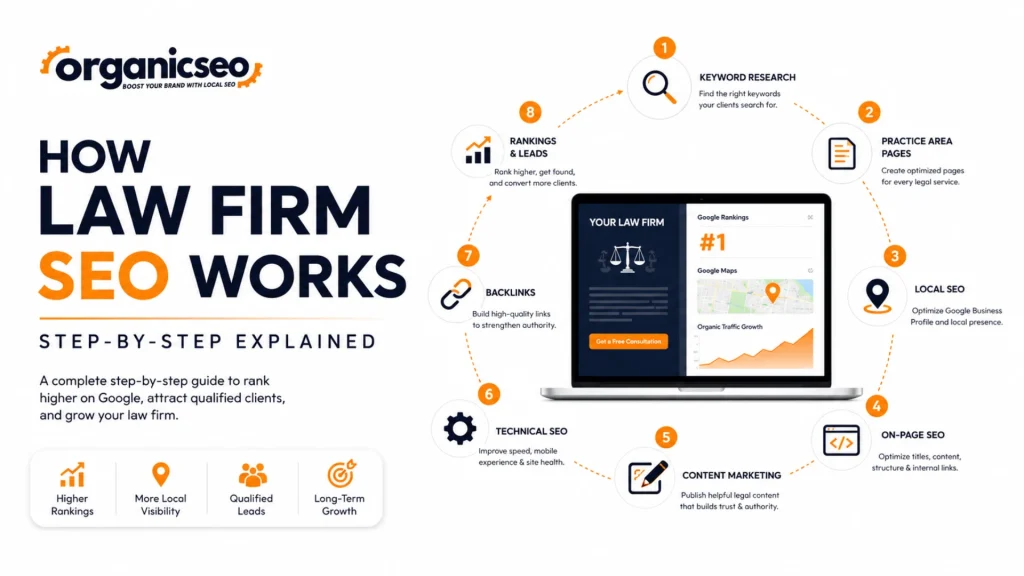
It involves several strategies working together, including:
- Keyword research
- Local SEO
- Website optimization
- Content creation
- Technical SEO
- Link building
- Google Business Profile optimization
The goal is simple: help potential clients find your law firm before they find your competitors.
For example, if someone searches:
- “personal injury lawyer near me”
- “divorce attorney in Dallas”
- “immigration lawyer Chicago”
SEO helps your website appear in those search results organically.
Unlike paid ads, SEO focuses on long-term visibility. Once your pages begin ranking well, they can continue generating traffic and leads consistently over time.
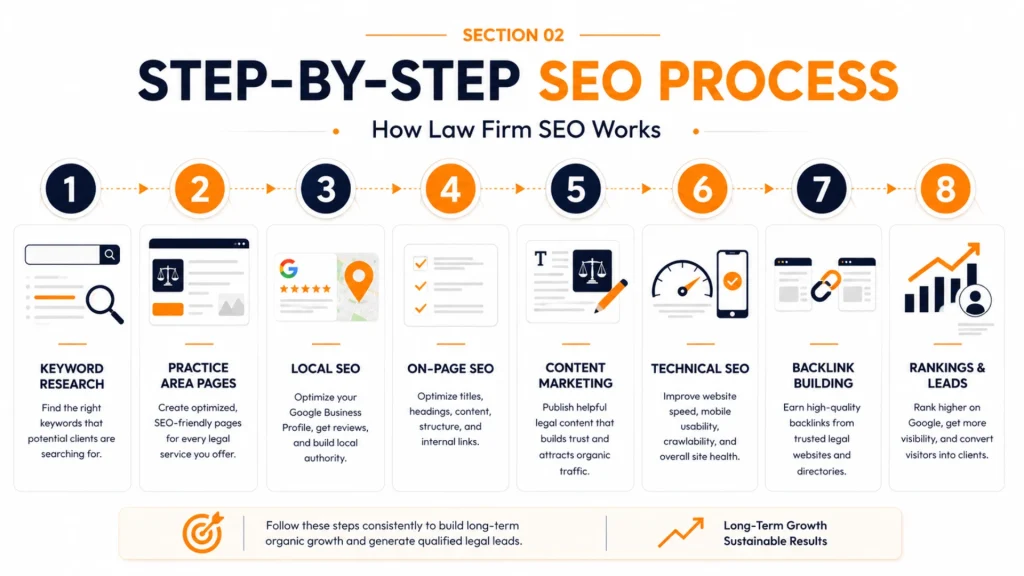
How Does Law Firm SEO Work?
Law firm SEO works by helping Google understand what legal services your firm offers, where you operate, and why your website deserves to rank higher than competing firms.
Google analyzes hundreds of ranking factors before deciding which pages appear at the top of search results. Some of the most important factors include:
- Relevance of content
- Website authority
- User experience
- Mobile friendliness
- Local location signals
- Backlinks from trusted websites
- Content quality and usefulness
Google first crawls your website, indexes your pages, and then evaluates how valuable your content is compared to other websites in the legal industry.
If your site provides strong answers, clear service information, and trustworthy signals, your rankings improve over time.
Step 1: Keyword Research for Legal Searches
Keyword research is the foundation of every successful law firm SEO strategy.
Before creating content or optimizing pages, you need to understand what potential clients are actually searching for online.
Understanding What Potential Clients Search For
Legal searches are highly intent-driven. People usually search because they need immediate help or information.
Examples include:
- personal injury attorney
- divorce lawyer near me
- immigration lawyer in Houston
- DUI attorney Chicago
- estate planning lawyer
Every practice area has different search behavior, competition levels, and client intent.
Search Intent Matters in Legal SEO
Not all searches are the same.
Some users want information:
- “What happens after a DUI arrest?”
Others are ready to hire:
- “best DUI lawyer near me”
Good law firm SEO targets both informational and commercial intent.
Informational content builds trust. Commercial pages generate leads.
Long-Tail Keywords Often Convert Better
Broad keywords are competitive and expensive.
Long-tail keywords usually attract more qualified clients because the search intent is clearer.
Examples:
- affordable family lawyer in Miami
- truck accident attorney in Los Angeles
- immigration attorney for work visa applications
These searches may have lower traffic, but they often bring stronger conversion opportunities.
Many SEO professionals use tools like:
- Google Autocomplete
- People Also Ask
- Google Search Console
- Ahrefs
- SEMrush
At Organic SEO IT, intent-based keyword research is one of the first things we focus on because traffic alone does not matter if it does not generate actual legal inquiries.
Step 2: Creating SEO-Friendly Practice Area Pages
Every legal service should have its own dedicated page.
One of the biggest mistakes law firms make is placing all services on a single generic page.
Google prefers focused, detailed pages that clearly explain one specific topic.
For example:
- Personal Injury Law
- Family Law
- Criminal Defense
- Immigration Law
- Estate Planning
Each page should fully explain:
- What the service includes
- Who it helps
- Common legal situations
- Local relevance
- FAQs
- Consultation information
Why Thin Pages Do Not Rank
Short pages with little useful information usually struggle to rank.
Google wants pages that genuinely help users understand the topic.
Strong legal service pages typically include:
- Detailed explanations
- Client-focused language
- Relevant FAQs
- Internal links
- Clear calls-to-action
Topical Authority Matters
Google rewards websites that consistently publish high-quality content around a specific subject.
If your website has multiple detailed pages related to personal injury law, Google begins recognizing your firm as more authoritative in that area.
This is called topical authority.
Step 3: Optimizing Local SEO for Lawyers
Local SEO is extremely important for law firms because most legal searches include location intent.
People often search:
- lawyer near me
- attorney in Dallas
- criminal defense lawyer Chicago
Google uses local ranking signals to decide which firms appear in local search results and Google Maps.
Google Business Profile Optimization
Your Google Business Profile plays a major role in local visibility.
An optimized profile should include:
- Accurate business name
- Address
- Phone number
- Website
- Office hours
- Service categories
- Reviews
- Photos
A properly optimized profile improves visibility in Google Maps and local searches.
NAP Consistency Matters
NAP stands for:
- Name
- Address
- Phone number
Your information should remain consistent across:
- Your website
- Legal directories
- Social profiles
- Google listings
Inconsistent information can confuse Google and hurt rankings.
Legal Directories Help Build Local Signals
Listings on trusted legal websites can improve visibility and credibility.
Examples include:
Reviews Influence Rankings and Trust
Positive reviews help both SEO and conversions.
Potential clients often compare reviews before contacting a law firm.
Google also considers review quality and consistency as local ranking signals.
Step 4: On-Page SEO Optimization
On-page SEO helps search engines understand your website content more clearly.
This includes optimizing:
- SEO titles
- Meta descriptions
- Header tags
- URLs
- Images
- Internal links
Why Website Structure Matters
A clear website structure improves both usability and crawlability.
A common structure looks like this:
- Homepage
- Practice area pages
- Location pages
- Blog articles
- Contact page
This organization helps Google navigate your website efficiently.
Internal Linking Helps Rankings
Internal links connect related pages together.
For example:
- A personal injury blog post can link to your personal injury service page.
- A DUI FAQ article can link to your criminal defense page.
Internal linking helps:
- distribute authority
- improve user navigation
- strengthen topical relevance
Step 5: Publishing Helpful Legal Content
Content marketing plays a major role in law firm SEO.
People search legal questions every day, and informative content allows your firm to appear during those searches.
Why Blogging Helps Law Firm SEO
Blogs help target informational keywords that service pages may not cover.
Examples:
- What should I do after a car accident?
- How long does divorce take?
- Can I refuse a breathalyzer test?
Educational content helps build:
- trust
- authority
- visibility
- topical relevance
Helpful Content Builds EEAT
Google values:
- Experience
- Expertise
- Authoritativeness
- Trustworthiness
Law firms that consistently publish accurate, useful legal content often perform better in search rankings.
AI Overviews and Featured Snippets
Modern SEO is increasingly influenced by AI-generated search experiences.
Well-structured content with:
- direct answers
- FAQ sections
- short explanations
- scannable formatting
has a better chance of appearing in:
- Featured Snippets
- People Also Ask sections
- AI-generated summaries
At Organic SEO IT, content strategy is often one of the biggest opportunities we identify during law firm SEO audits.
Step 6: Technical SEO for Law Firm Websites
Technical SEO ensures your website functions properly for both users and search engines.
Even great content can struggle if the technical foundation is weak.
Important Technical SEO Factors
These include:
- Mobile responsiveness
- Website speed
- HTTPS security
- Crawlability
- XML sitemaps
- Proper indexing
Why Website Speed Matters
Slow websites create poor user experiences.
If pages take too long to load, visitors may leave before contacting your firm.
Google also considers website page speed as a ranking factor.
Mobile Optimization Is Essential
Most legal searches now happen on mobile devices.
Your website should:
- load quickly on phones
- display correctly on smaller screens
- have readable text
- use easy navigation
A mobile-friendly website improves both rankings and conversions.
Step 7: Building Authority with Backlinks
Backlinks are links from other websites pointing to your website.
Google treats backlinks as trust signals.
Why Backlinks Matter
If reputable websites mention or link to your law firm, Google sees your site as more credible.
High-quality backlinks can improve:
- rankings
- authority
- domain strength
- organic visibility
High-Quality Links vs Spam Links
Not all backlinks help SEO.
Good backlinks usually come from:
- legal directories
- local organizations
- industry publications
- news websites
- guest posts
Spammy or low-quality backlinks can actually harm rankings.
Quality matters far more than quantity.
How Long Does Law Firm SEO Take?
Most law firms begin seeing noticeable SEO improvements within 3 to 6 months, while highly competitive markets may take 6 to 12 months or longer.
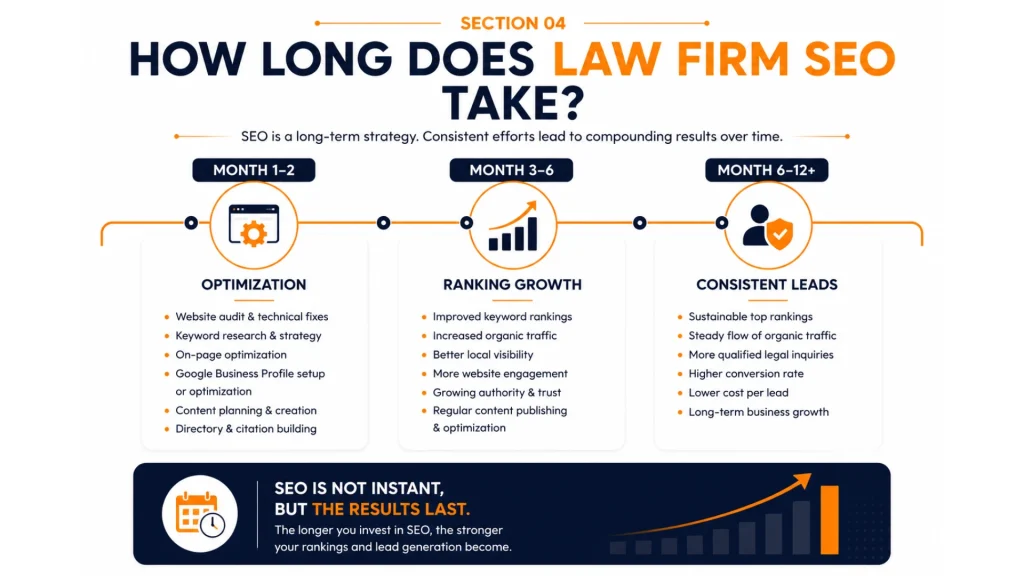
SEO is not an instant strategy.
Results depend on:
- market competition
- website age
- content quality
- backlink profile
- technical optimization
- local competition
Consistent work usually produces better long-term growth than short-term shortcuts.
Common Law Firm SEO Mistakes
Many law firms struggle with SEO because of avoidable mistakes.
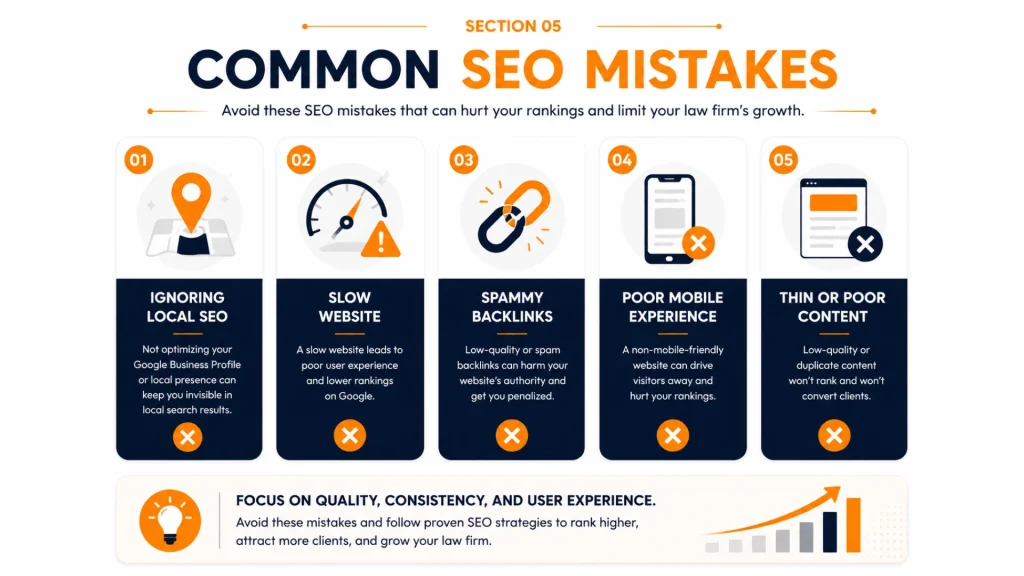
Common issues include:
- Keyword stuffing
- Thin content
- Duplicate city pages
- Ignoring local SEO
- Slow websites
- Poor mobile usability
- Buying spam backlinks
SEO works best when the focus stays on user experience and content quality.
Does SEO Really Work for Law Firms?
Yes, SEO works extremely well for law firms because legal searches often come with strong hiring intent.
When someone searches:
- “car accident lawyer near me”
- “immigration attorney consultation”
- “best divorce lawyer”
they are often actively looking for legal help.
Good SEO allows your firm to appear during these high-intent moments.
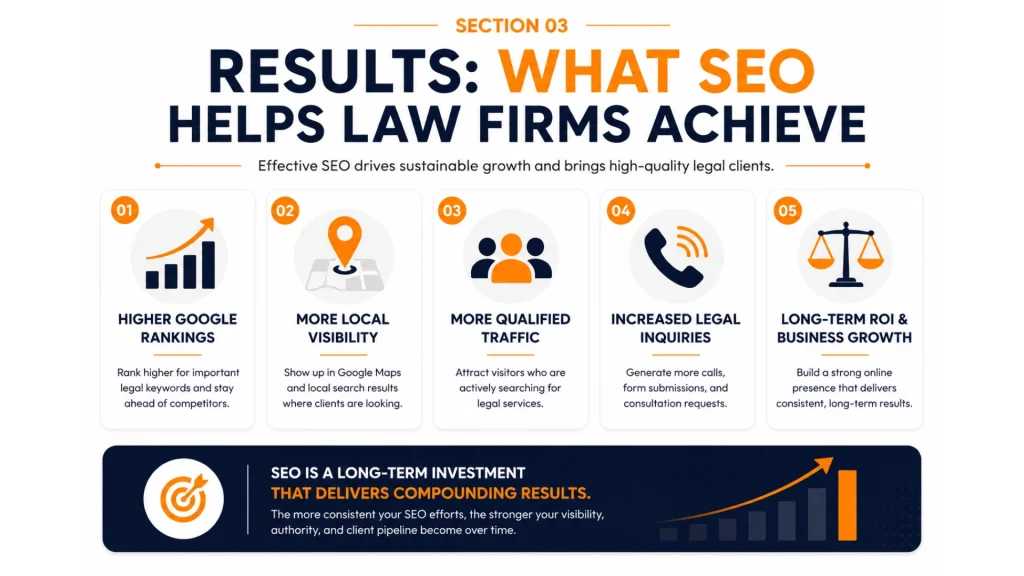
Over time, this can generate:
- consistent leads
- lower acquisition costs
- stronger online authority
- better long-term visibility
Why Many Law Firms Hire SEO Agencies
Law firm SEO involves multiple moving parts.
Managing:
- content
- technical SEO
- backlinks
- local optimization
- analytics
- strategy
requires time and expertise.
That is why many firms work with SEO professionals instead of trying to manage everything internally.
At Organic SEO IT, we help law firms improve organic visibility through technical SEO, local optimization, authority-focused strategies, and content systems designed for long-term growth.
Final Thoughts
Law firm SEO is not just about adding keywords to a website.
It is a complete system that helps search engines understand:
- what your firm offers
- where you operate
- why clients should trust you
From keyword research and local SEO to content creation and technical optimization, every step contributes to stronger online visibility.
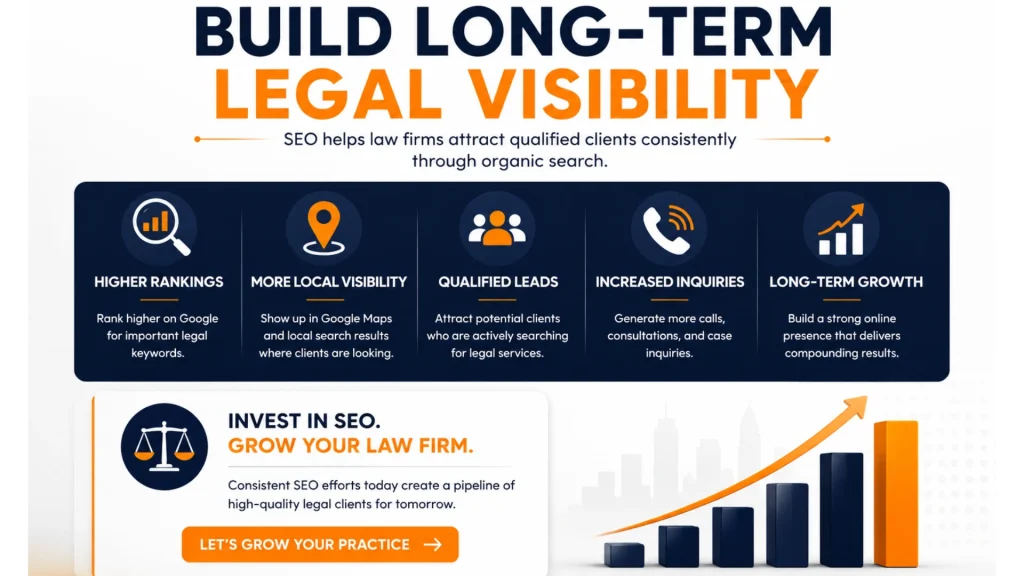
Law firms that invest in SEO early often build long-term advantages that continue generating leads for years.
Whether you are a solo attorney or a growing legal practice, understanding how law firm SEO works is the first step toward building a stronger online presence and attracting more qualified clients organically.